Category: Marketing performance
Industry: B2B
Project type: Audit, rebuild and optimisation
Completed: June 2025
Delivery: Six-month engagement
Markets: United States and United Kingdom
Platforms: Google Ads, SEO, LinkedIn, GTM, Looker Studio, CRM and email marketing
The business was targeting a highly specific professional audience across the United States and United Kingdom, but lead volumes remained low.
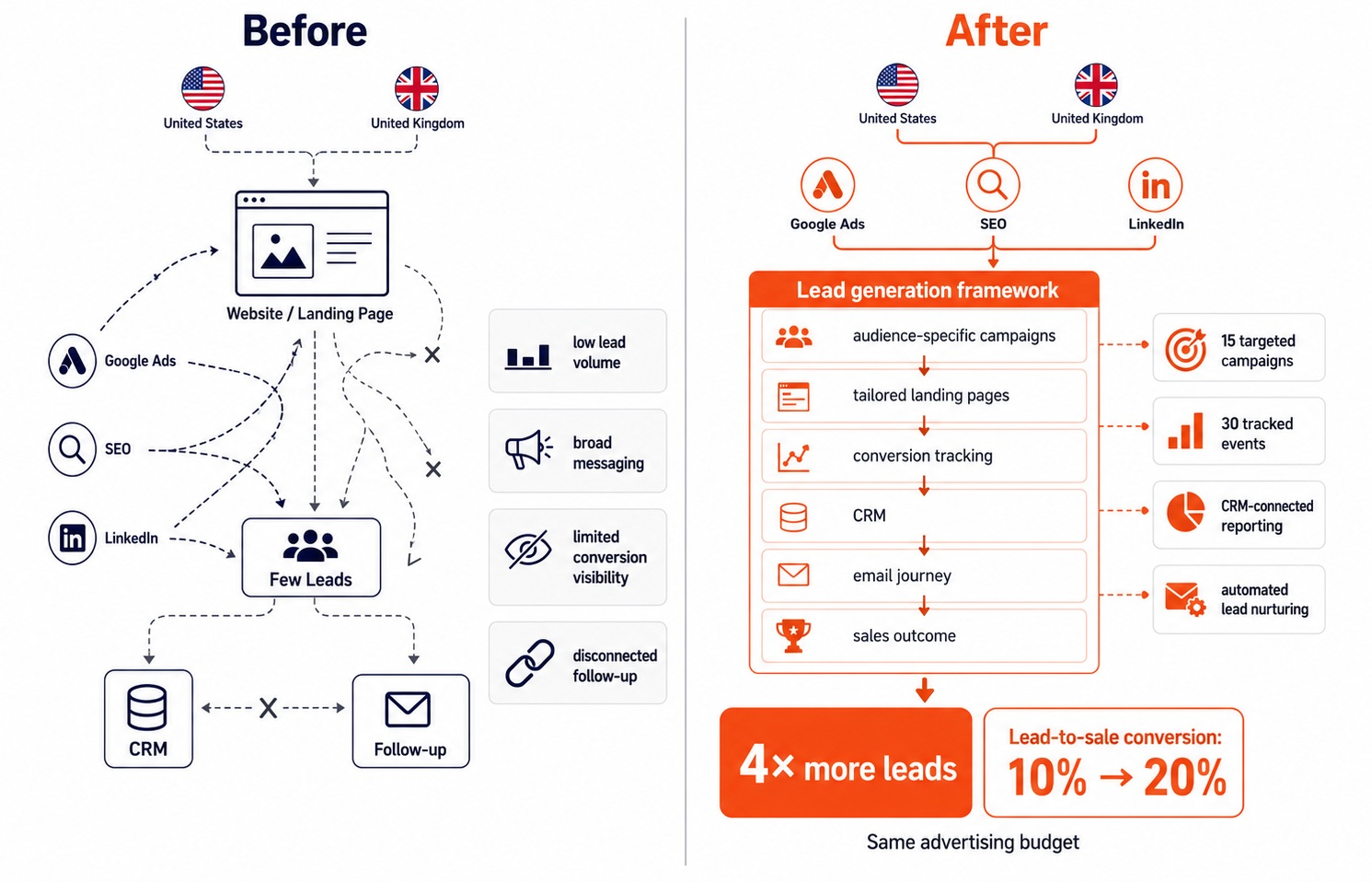
Following an initial audit, the project expanded beyond campaign optimisation. Product and landing pages were rebuilt, measurement was strengthened, CRM data was connected to marketing reporting, and different audience groups were given more relevant messages and conversion journeys.
Over six months, lead volume increased fourfold without increasing advertising spend. The proportion of leads converting into sales also increased from 10% to 20%.
Project overview
| Project facts | Details |
|---|---|
| Service | International lead generation and conversion optimisation |
| Target markets | United States and United Kingdom |
| Initial problem | Low lead volume from a highly specific target audience |
| Acquisition channels | Google Ads, SEO and supporting LinkedIn content |
| Campaign rebuild | 15 Google Ads campaigns created around audience, intent and market differences |
| Measurement | 30 GTM events implemented across the lead journey |
| Reporting | Looker Studio dashboards connected with CRM lead outcomes |
| Lead nurturing | Automated email journeys created for new leads |
| Performance outcome | Four times more leads with the same advertising budget |
The challenge
The business operated in two large international markets, but its potential customer base was highly specialised.
This created a different type of lead-generation challenge. The overall markets were substantial, but the number of genuinely relevant prospects was narrow. Broad targeting could generate traffic without producing qualified leads, while overly restrictive targeting could limit campaign delivery.
The United States and United Kingdom also required different terminology, search language and messaging. The same campaign structure and landing page copy could not simply be applied across both markets.
The existing activity was generating leads, but not at the volume needed to support growth.
Audit first, rebuild second
The project began with an audit of the existing website, product pages, landing pages, advertising activity, SEO visibility, conversion tracking and lead journey.
The audit found that campaign changes alone were unlikely to solve the lead-volume problem. The landing experience, audience segmentation, measurement framework and follow-up process also needed improvement.
The priority plan included:
- rebuilding key product and landing pages
- restructuring Google Ads
- creating more specific audience groups
- adapting terminology and messaging for each market
- improving conversion measurement
- connecting marketing data with CRM outcomes
- building a structured follow-up journey for new leads
This created a complete lead-generation framework rather than treating advertising, website conversion and follow-up as separate activities.
What was delivered
The six-month engagement included:
- rebuilt key product and landing pages to improve conversion
- completely restructured the Google Ads account
- created 15 campaigns across different audience and intent groups
- developed different messaging for the United States and United Kingdom
- directed each audience to more relevant landing pages
- supported organic acquisition through SEO
- used LinkedIn content to reinforce campaign activity
- implemented 30 GTM events across the customer journey
- created Looker Studio dashboards
- connected reporting with CRM data to track lead outcomes
- built automated email journeys for new leads
The reporting framework made it possible to assess not only lead volume, but also what happened after each lead entered the sales process.
How the lead-generation system was improved
The new campaign structure was built around audience needs, search intent and differences between the two markets.
Rather than directing all prospects through the same campaign and landing page experience, the new framework used:
- separate campaign groups
- more specific audience targeting
- market-appropriate terminology
- different value propositions
- tailored advertising messages
- landing pages aligned with each audience
- CRM outcomes to assess lead quality
This allowed optimisation decisions to be based on more than clicks and form submissions. Campaign performance could be assessed against actual lead progression and sales outcomes.
Before and after
| Before | After |
|---|---|
| Low lead volume | Four times more leads |
| One broader campaign approach | 15 campaigns structured around audience and intent |
| Similar messaging across markets | Market-specific language and positioning |
| Generic landing experiences | Rebuilt pages aligned with campaign audiences |
| Limited visibility after form submission | CRM-connected lead outcome reporting |
| Incomplete journey measurement | 30 GTM events across key interactions |
| Manual or inconsistent follow-up | Automated email lead journeys |
| 10% lead-to-sale conversion | 20% lead-to-sale conversion |
| Growth dependent on higher spend | Lead growth achieved with the same advertising budget |
The outcome
The project created an integrated international lead-generation framework across advertising, SEO, content, landing pages, measurement, CRM reporting and email follow-up.
Lead volume increased fourfold while advertising spend remained at the same level.
The proportion of leads converting into sales also increased from 10% to 20%.
The completed framework provided:
- stronger lead-generation efficiency
- clearer audience segmentation
- more relevant market-specific messaging
- improved landing page conversion
- visibility from acquisition through to sales outcome
- more reliable optimisation data
- a structured follow-up journey for new leads
- a stronger foundation for future international growth
Need more leads from a specialist audience?
KNOP can review the complete lead journey, identify where demand is being lost and improve the connection between campaigns, landing pages, tracking, CRM data and follow-up.